Let’s talk about sales page – it’s a specialized website landing page designed to turn visitors into paying customers.
We all know ecommerce sites have product pages to display information about their items, right? But savvy online businesses use separate sales pages that speak directly to the customer and focus completely on encouraging purchases.
These specially-designed pages are all about selling. They don’t simply present the features and specs of a product. Instead, they speak to the visitor’s needs and pain points, clearly articulate the product’s benefits, provide social proof, and include a compelling call-to-action.
In other words, sales pages convert casual website visitors into paying customers. They are often the difference between success and failure for an ecommerce business.
But what exactly goes into crafting high-converting sales pages? What elements are essential? And how do you optimize these pages to maximize revenue?
I’ll be covering all of this and more in this article. You’ll learn what makes sales pages unique, how to create one for your business, and which industries can benefit the most from investing in dedicated sales pages.
Let’s get started!
What is a Sales Page?
At the most basic level, sales pages are dedicated web page that’s specifically designed to persuade visitors to take a desired action. This could be making a purchase, signing up for a free trial, or requesting a quote.
The main goal is to convert website traffic into paying customers or qualified leads.
They web pages use copy, design elements, and psychology to guide visitors through the sales process. The page speaks directly to the ideal customer and highlights the biggest benefits of the product or service.
These web pages are all about articulating value, building trust, and overcoming objections. That’s why the copy and layout are optimized for conversions, not just information.
For example, a SaaS company’s product page would focus on itemizing software features and capabilities. But the sales page would focus on positioning the software as the ideal solution for the target customer’s needs.
The sales landing page copy might say something like: “Tired of missing deadlines? Our project management software will help you hit timelines and keep clients happy.” See the difference?
While product pages inform, sales pages persuade. They speak to emotions and aspirations using psychological triggers that motivate purchases.
Now that you understand the distinct purpose of sales pages, let’s look at some of the key ingredients that set them apart.
Key Elements: What’s Included in a Sales Page?
Sales pages include several key elements that are designed to persuade and convert visitors. Some of the most important components are:
Headlines and Subheadings – Compelling headlines capture attention and set the tone. Subheadings break up copy and improve skimmability.
Product Photos/Videos – High quality visual content demonstrates the product and reinforces the copy.
Product Description – This overviews the product or service’s capabilities and features.
Benefits List – Bulleted list of the concrete benefits customers will gain. Focused on you, not we.
Customer Testimonials – Direct quotes from satisfied customers provide credibility.
Call-to-Action Buttons – Clear call-to-action buttons allow visitors to easily purchase, signup, etc.
Trust Signals – Features like security badges, guarantees, or certifications build trust.
Minimal Navigation – Sales pages limit navigation so visitors focus only on the CTA, not clicking elsewhere.
Social Proof – Awards, media logos, number of users/customers establishes authority and social proof.
Each element has a psychological purpose, guiding the visitor through the sales process. Combined strategically, these ingredients speak to emotions and logic, overcoming objections and positioning your product as the ideal solution.
Now let’s compare sales pages to basic product pages…
Landing Page: Product pages vs. Sales pages?
Most ecommerce sites have product pages that provide visitors with details and information about an item. These are focused on displaying features, specs, options, and visuals.
Sales pages serve a different purpose – to persuade the visitor to make a purchase or sign up.
While product pages are informative, sales pages are promotional. Here are some key differences:
Product pages itemize features and technical specs. Sales pages focus on emotional hooks, value propositions, and benefits.
Product pages take an objective, informational tone. Sales pages use persuasive language focused on you vs. we/us.
Product pages try to be comprehensive about options and variations. Sales pages simplify the decision-making process down to one highly-targeted offer.
Product pages may link off to other pages on a site. Sales pages limit navigation to keep focus on the CTA.
Product pages highlight specs and dimensions. Sales pages emphasize how the product will improve the customer’s life.
Product pages are evergreen. Sales pages can be optimized for promotions, seasonal offers, or events.
Product pages function even without great copy. Sales pages rely heavily on persuasive writing.
The goal of a product page is to inform and provide details to site visitors. The goal of a sales page is to sell. This means optimizing the copy, layout, offer, and entire user experience for higher conversions.
Now let’s get into how to create an effective sales page…
How To Write Sales Pages?
How to create a sales page?
Creating high-converting sales pages takes strategic planning and execution. Follow these key steps:
Research your target audience – Get clear on who your ideal customers are and what motivates them. Understand their goals, challenges, and hesitations.
Identify the core customer problem or need – Determine the primary pain point your product or service solves. Craft messaging focused on relieving this pain.
Develop a compelling headline – The headline is one of the most important elements. It needs to capture attention and speak directly to the identified customer problem.
Write benefit-focused copy – Structure copy around how the product improves customers’ lives. Focus on the benefits gained, not features. Use persuasive language.
Create a strong value proposition – Articulate why you are the best solution compared to alternatives. This establishes value quickly.
Optimize page flow and layout – Break up copy with subheadings, images, testimonials, etc. Ensure page flows well and guides visitors down the page.
Add social proof elements – Build credibility by including testimonials, awards, certifications, media logos, etc.
Feature clear CTAs – Use action-driven language. Make the buttons visually prominent on the page.
Improve page conversion rate – Use A/B testing to experiment with copy, design, offer, etc. and improve conversion metrics.
Make it mobile-friendly – Optimize page responsiveness for all devices. Mobile optimization is critical.
Following a customer-focused process allows you to intentionally craft sales pages that truly resonate with your target audience and convert at high rates.
Now let’s discuss which industries and businesses can especially benefit from these landing pages…
What Industries Should Use Sales Pages?
Nearly any business selling products or services online can benefit from using dedicated pages. However, they are especially effective for:
SaaS Companies – Sales pages are crucial for SaaS companies selling software subscriptions. They allow articulating value prop and guiding visitors through onboarding process.
Ecommerce Brands – Persuasive sales pages on ecommerce sites can boost conversion rates. They convince shoppers to click “buy” instead of just browsing.
Digital Products – Whether it’s eBooks, online courses, templates, etc. sales pages help creators turn browsers into buyers.
Coaches & Consultants – Professional service providers like coaches, consultants, agencies, etc. rely on sales pages to convert leads.
Nonprofits – Nonprofits need landing pages when fundraising. They motivate donations or other support for causes.
Webinars/Events – Help convert registrations for webinars, virtual events, conferences, etc.
High-Ticket Products – Big-ticket items especially benefit from sales pages. More complex purchases require more information before buying.
Any business that struggles with converting traffic into sales can implement sales pages as part of their lead gen and ecommerce strategy.
But should every sales page be long and comprehensive? Let’s discuss the difference between short-form and long-form next…
Short-form sales pages and Long-form sales pages?
Sales pages typically fall into two formats – short-form or long-form.
Short-form sales pages:
Get straight to the point
Use concise, hard-hitting copy
Typically 250 words or less
Often use a long scrolling page style
Great for simple or impulse purchase products
Long-form sales pages:
Provide extensive details and information
Use lengthy, educational copy
Often over 2,000+ words
Break content into sections with visuals
Better for complex or high-priced products
Short-form pages work well when you need to convey a strong value prop and CTA very quickly. They’re great for lower-cost offers or when customers need minimal information to make a purchase decision.
Long-form pages allow you to educate prospects, build authority, and fully address any concerns they may have before buying. But long-form pages require more effort to create and optimize.
In general, short-form works best for:
Simple or impulse purchases
Low-cost items
When visitors already know what they want
Long-form works best for:
High-ticket or complex products/services
When building credibility is important
Target audience expects details before buying
When should you use a long-form sales page?
Long-form sales pages work well when:
You are selling a high-priced product or premium service. Customers want details before committing.
Your offering is complicated or technical. More information helps customers understand value.
Customers need education on the problem you’re solving for them.
You are making a “big promise” that requires credibility. More content builds authority and trust.
Your target audience expects a lot of information before making a purchase decision.
You offer many product options, features, or customization. Details help guide customers.
There are a lot of customer concerns or objections that need addressing.
Your product/service has a longer sales cycle with more touchpoints.
You want to incorporate storytelling or origin stories into your messaging.
Some examples where long-form works well:
Software-as-a-service with multiple features
High-priced online courses or coaching programs
Large equipment, machinery, vehicles
Medical devices or health-related products
Enterprise level software or services
Specialized consulting services
Luxury or specialty retail items
The more complex the offer, the bigger the investment for customers, the more you may need sales pages that provides detailed content.
Tips for Creating Effective Sales Pages
Crafting a high-converting sales page takes strategic planning and execution. Here are some top tips:
Clearly articulate your value proposition right away – Establish the core value and benefits immediately so customers “get it” fast.
Focus messaging on your customers, not yourself – Use language focused on “you” not “we”. Speak to their needs and goals.
Limit choices and distractions – Present one highly targeted offer instead of multiple options to avoid analysis paralysis.
Use quality images, infographics and video – Visuals grab attention, demonstrate products, and reinforce copy.
Structure copy with subheads and bullet points – Break up blocks of text for improved readability and skimming.
Provide social proof elements – Testimonials, customer logos, reviews and case studies build credibility and trust.
Make the CTA buttons clear and prominent – Multiple touchpoints for conversion create urgency.
Usescarcity and exclusivity tactics – Limited-time offers or inventory create urgency to act now.
Personalize when possible – Using first names and dynamic content improves connection.
Eliminate generic claims – Back up claims with stats, guarantees, certifications or demonstrations.
Use a clear, single-focused headline – Compelling headlines capture attention and set the tone.
Make it mobile-friendly – Optimize for smartphones and tablets with responsive design.
Continuously improve based on data – Use heatmaps, analytics and A/B testing to optimize conversions.
Following these best practices will help you craft pages that engage users and drive results.
Now let’s look at some stellar examples of these pages..
Inspiration: Creative Sales Page Examples
Looking at examples of high-converting sales pages can provide inspiration and ideas for what works. Here are a few great examples:
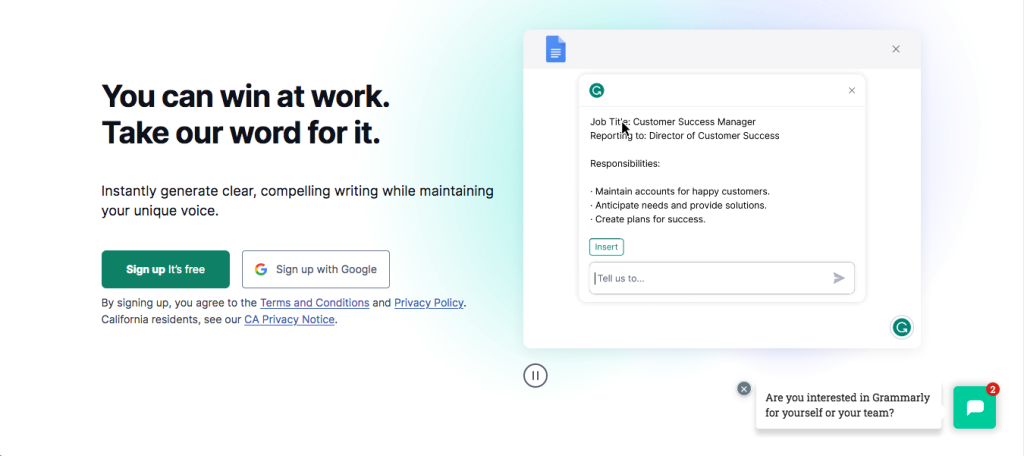
Grammarly – For their premium writing assistance tool, Grammarly uses a video demo right up top to quickly establish the value proposition visually. The rest of the page focuses on relieving customer pain points around writing mistakes.
Oura Ring – This web page for a health tracking ring has customers center stage. The compelling testimonial headlines and excellent photography showcase real customers and reinforce positioning it as a “life-improving” product.
Athletic Greens – This supplement company uses a long web page to educate customers on health issues and establish themselves as experts. Sections like “Why Athletic Greens Works” build credibility.
Calendly – The sales page copy positions Calendly as the solution to scheduling chaos. It speaks directly to the overwhelmed meeting scheduler with empathetic language.
Studying competitors and leading companies in your space can reveal good sales page strategies to model. Analyze why their pages convert and apply those lessons.
Now let’s wrap up with some key takeaways…
Sales Page Key Takeaways and Conclusion
Sales pages play a crucial role in converting website visitors into paying customers. When designed effectively, they can significantly improve conversion rates and revenue for businesses.
Here are some key takeaways:
Sales pages use copy, design, and psychology to guide visitors to a purchase decision. Product pages merely inform.
Headlines, visuals, benefits focused copy, social proof, and clear CTAs are essential elements of a sales page.
Both short-form and long-form pages have their place depending on the type of offer and customer expectations.
Industries like SaaS, ecommerce, coaching, and enterprise sales rely heavily on sales pages for lead gen.
They are optimized for converting visitors not just informing them. Testing and data should drive continuous optimization.
Compelling and benefit-focused copy combined with a customer-centric design results in high-converting sales pages.
Looking at examples from successful companies can provide inspiration for what effective sales pages look like.
These landing pages require strategy and messaging finesse to create. But they deliver tremendous value for online businesses by turning browsers into buyers.
Hopefully this gives you a good overview of what sales pages are and how to start creating effective ones for your business.